Themes and Looks in Roblox Makeup All Stars
The game does not publish a theme list, so the skill is reading whatever theme you are given. Name the kind of thing the theme is, pick the loudest possible answer, choose two colours and one accent, and put the detail where the eye lands. Obvious beats clever in a ten-player room.
Every round of Makeup All Stars starts with one instruction: a theme. Everything after it — hair, lashes, skin, gloss, the palette — is you answering it. This page is about the answering.
First, so nobody wastes a search: the game does not publish a theme list. There is no theme calendar in the store description and no official post enumerating themes, so sites printing "all Makeup All Stars themes" are transcribing what they saw or inventing it. What follows is craft, not a spoiler list.
Read the theme in thirty seconds
Four questions, in this order, before you touch a single tool:
- What kind of thing is being named? A mood, a place, a colour, a character, an object. The category decides which tool does the heavy lifting.
- What is the loudest possible answer? Not the cleverest — the most obvious. In a ten-player room, obvious wins.
- Which two colours carry it? Pick them before you paint anything.
- Where does the eye land? One focal point: eyes, or lips, not both at full strength.
If you cannot answer all four in half a minute, you will spend the round scrolling tools instead of building, and the look will read as a pile of parts.
The five shapes a theme takes
Themes are not random; they cluster. Recognising the shape tells you what to build first.
| Shape | What it usually asks for | Build order |
|---|---|---|
| A mood (soft, dramatic, sweet, fierce) | expression and colour temperature | eyes and lips first, hair second |
| A place (somewhere you can picture) | props, palette, era | hair and silhouette first, colour second |
| A colour | discipline — one hue family, one accent | skin and hair to support it, then makeup |
| A character or role | recognisability at a glance | the strongest single sign of that role |
| An object or texture (something shiny, something floral) | finish and detail placement | finish choices, then one detail placed where the eye lands |
The mistake that costs rounds is treating every theme like a mood theme — painting a beautiful face that answers nothing. A place theme is usually won by hair and silhouette before makeup is considered.
Two colours and one accent
The palettes that read at card size are almost always small. Pick a dominant colour, a supporting neutral, and one accent that you use sparingly — a gloss, a lash line, a single highlight.
Three mid-tone colours compete and turn grey in a small image; one bright colour against a neutral survives the shrink to a card. That single rule does more for a look's score than any amount of blending.
If the theme names a colour, treat it as the dominant, not the only: the look still needs a neutral surface (skin, hair) or the colour has nothing to sit against.
The three levers: hair, lashes, lips
The game separates hair and lashes from makeup, and that separation is a gift — it gives you three levers that read at different distances.
- Hair frames everything. It is the largest shape on the card and the cheapest way to make a look recognisable. Change the hair and the same face reads as a different person.
- Lashes set the expression. Because lashes are their own slot, they change the read of the eye area more than any other small tool. Two heavier lash styles are VIP-only, but the slot itself is not.
- Lips anchor the lower half. A strong lip colour balances a strong eye shape. Two strong points at once cancel each other out.
Finishes matter here too: Metallic and Glitter are paid finishes, and they are the ones that catch light. If you are working with flat colour, put your effort into shape instead — a bold eye shape with a matte finish reads further than a subtle look with a fancy finish.
Where the eye lands
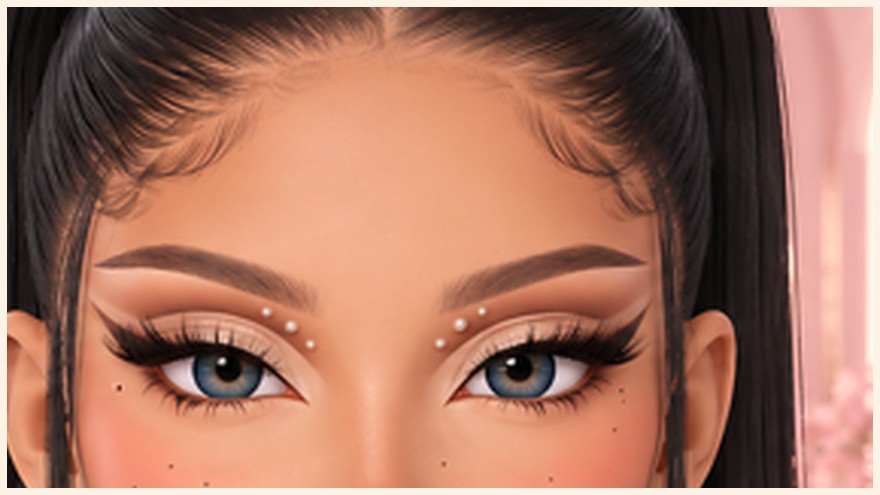
A card in a row of ten gets about two seconds. The room reads silhouette, then colour block, then focal point, then detail.
That is your build order, reversed: decide the silhouette, block the colours, place the focal point, then add only detail that survives at small size. A precise inner-corner highlight vanishes at card size; a lash line that doubles the eye's apparent width does not.
Before you submit: the five-second check
| Check | Pass condition | If it fails |
|---|---|---|
| Theme read | A stranger could name the theme from the look | Add the most obvious sign, remove the clever one |
| Colour count | Two colours plus one accent | Delete the third colour |
| Focal point | Exactly one | Pull back on the weaker of eyes/lips |
| Distance | Reads from across the room | Increase contrast, simplify shapes |
| Finish | Detail is visible at card size | Move detail to silhouette or colour instead |
Five questions, no tools, about five seconds. It catches most of what a rushed round gets wrong.
When the theme is abstract
Abstract themes — a feeling, a season, a sound — are where rooms split. Two approaches work:
Translate it into a colour and a texture. If the theme suggests warmth, answer with a warm palette and a soft finish. You are not illustrating the word, you are answering its temperature.
Translate it into a character. Build the person who has that mood — the hair, the lash weight, the lip. Rooms vote for people more readily than for concepts.
What fails is rendering the word literally with face paint: it reads as noise at card size, and the room never gets the joke.
Keeping track of what themes appear
Themes rotate with the game's updates, and the store title's bracketed tag is the closest thing to an announcement the game provides. The dated record of what changed when — game, passes, badge — is on the update timeline page.
For the battle format itself (round order, voting, rewards), read beauty battles. For the tools and the loop, start at how to play.