Beauty Battles in Roblox Makeup All Stars
A beauty battle is a themed round: everyone builds a look to the theme, the looks go up for the room to see, and players vote on each other's work. Rewards arrive after the round, and the same loop feeds the global leaderboard behind the top 10 badge.
A beauty battle is the part of Makeup All Stars where the styling stops being private. The game names a theme, everyone in the 10-player server builds a look against it, the entries go up, and the room votes for its favourite creations. Coins arrive after that. Three different mechanics are stacked in that one sentence — a timed brief, a public gallery, a peer vote — and each of them punishes a different beginner habit.
The theme is the rubric
There is no scoring screen to read and no hidden judges: the theme is the entire brief, so the first skill here is listening, not painting. A look that answers the theme in one glance beats a more technical look that answers a different question, because the voters just spent the same two minutes on the same words.
A thirty-second read that works on any theme:
- Name the subject. Is the theme a mood, a place, a colour or a character? Each one wants a different approach — a mood wants colour and expression, a place wants props and palette, a colour wants saturation discipline.
- Pick the palette before the tools. Two dominant colours and one accent beats five colours that all shout.
- Choose one focal point. Eyes or lips, not both at full strength. The room needs somewhere to land.
That is it. The rest of the round is execution.
What the room actually sees
This is the gap that loses most rounds. You spend two minutes on a look in the editor, at full size, with your face about 40 centimetres from the screen. The room sees it as a card, on a phone, for a couple of seconds.
| You see | The room sees |
|---|---|
| Fine lash detail and individual hairs | A silhouette and a colour scheme |
| A subtle gradient across the cheek | One flat area of colour |
| A clever reference in the eye makeup | Nothing, unless the shape reads at a glance |
| The whole face, framed | A small card in a row of ten |
Design for the right-hand column. The most reliable way to do it is to build the look in blocks — hair, skin, one big eye shape, one lip colour — then only add detail if the blocks already read.
Where looks actually win
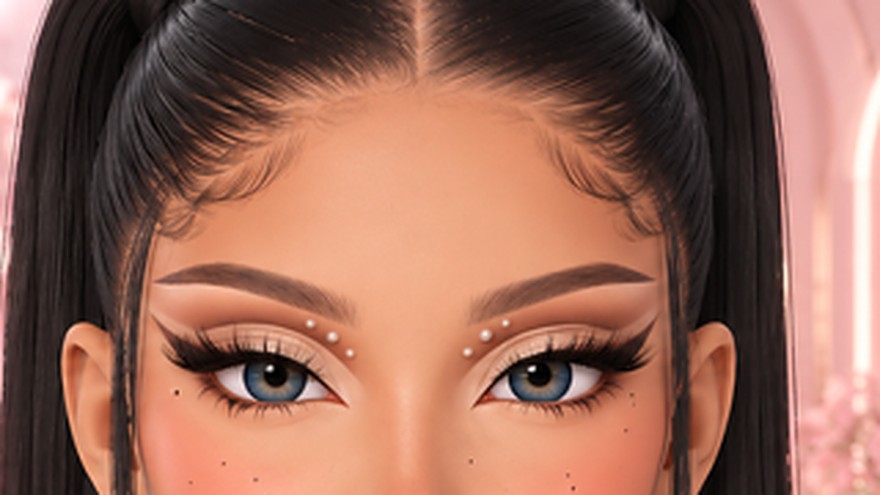
Silhouette first. Hair is the largest shape on the card and the cheapest way to make a look recognisable. A theme about a place or a period is often won by the hair before the makeup is even considered.
Colour contrast over colour quantity. One bright colour against a neutral reads at card size; three mid-tones turn grey. If you only change one thing about how you build, make it this.
Lashes earn their slot. Lashes are separately customisable in this game, which is unusual, and they change the read of the eye area more than any other small tool. Drama and Extra are the VIP pair; free players still have lashes to work with, so use the slot.
Stop when the theme is answered. Rounds are timed, and the last thirty seconds are usually spent ruining a look that was already finished. If a stranger could name the theme from your look, you are done.
The vote, and why you should take it seriously
Voting is not an add-on to the battle; it is how the room ranks the entries. The game's own description lists "vote for your favourite creations" alongside competing, which tells you the developer treats the vote as part of the loop rather than a courtesy.
Two things follow. First, vote for the look that answered the theme — the room's taste is a shared standard, and voting on-theme looks is how that standard stays useful. Second, watch what wins. Ten-player rooms are small enough that patterns show up quickly: the same kinds of looks keep placing, and those patterns are free coaching.
Rewards, and what they are not
Rounds pay coins. Coins buy items in the daily shop. That is the reward loop as the game describes it, and it is worth being blunt about what it does not include: there is no separate battle currency, no ranked season pass advertised on the game's Roblox page, and nothing in the store description suggests that winning a round unlocks a look directly. Winning earns you coins and reputation in the room; the items come from the shop and the passes.
The one competitive trophy is a leaderboard outcome, not a battle result — the top 10 badge, held by 135 players. See the badge page.
Why the loop is built this way
A 10-player server with a timed brief and a peer vote is a design choice with consequences, and they all favour speed:
- Short rounds mean a session is a series of small attempts rather than one long project.
- Small rooms mean your work is actually seen; in a 30-player server, half the entries get scrolled past.
- Peer voting means the standard is social, not technical. You are not being graded by an algorithm that rewards brush precision.
- All-device support means the ceiling is deliberately low — nobody is winning because they have a stylus and a 4K monitor.
If you are coming from a creative game where detail is the point, this will feel blunt for a round or two. Then it becomes a different skill: making a decision fast and committing to it.
Losing patterns to cut
- Five ideas in one look. The room cannot find the theme.
- Detail you cannot see at card size. Effort nobody receives.
- Copying last round's winner on a different theme. The pattern that won was fitted to that theme.
- Skipping the vote. You lose the only free feedback channel in the game.
- Blaming the vote. In a ten-person room, a look that reads clearly places.
The round mechanics in order are on how to play Makeup All Stars on Roblox; if you have not spent anything yet, the beginner guide covers the pass decision in plain numbers.